Showing posts with label downtown eastside. Show all posts

Thursday, January 15, 2009

Mark Your Calendars - Second Annual Poverty Olympics (Feb 8)


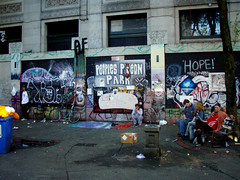
This family-friendly event will include a Torch Parade (starts at 380 E. Hastings at 12:30–come and join!), mascots Creepy the Cockroach, Itchy the Bedbug, and Chewy the Rat, Opening and Closing Ceremonies, events like Skating around Poverty and the Housing Hurdles, a special appearance by Mr. Con Dough. Cockroach Cake will be served. Free. Sponsored by Raise the Rates, Carnegie Community Action Project, Vancouver Area Network of Drug Users, Power to Women, Streams of Justice, BC PWA, Downtown Eastside Neighbourhood House. For info or to get involved call 604 729-2380.

Please feel free to distribute information about this event far and wide, and check out the Poverty Olympics website at http://povertyolympics.ca. Hope to see you there!

SUNDAY FEB. 8

12:30 Torch Parade

starts at VANDU 380 East Hastings

1pm Opening Ceremonies

at the Japanese Language School

487 Alexander Street

Family Friendly / Free Admission

Everyone Welcome!

Thursday, May 29, 2008

Who Needs Insight on Insite?


Eastside
Originally uploaded by Daquella manera
Federal Government Health Minister Tony Clements prefers overdoses leading to death, than safe injection interventions that could lead to health. Appallingly, the Federal Government has made a decision to take the province to court after the BC Supreme Court's decision to support Insite.

Living in Vancouver, it is clear that drastic measures, services, and programs are needed to solve the issues. What is seen on the surface, is rarely ever the cause. While Insite may not be perfect, and it may leave a lot to be desired, it is the first positive step taken in Canadian society to move further forward with progressive and proactive measures that could lead to recovery.

Saving lives from this affliction is far more complex than a safe injection site. That safe injection site, however, becomes a valuable gateway to intervention; coaxing jaded and cynical people off the street who have been abused repeatedly. They might consider surrendering their negative lifestyle to the possibility and hope that our society's limited programs and services can help them get their lives back together.

Change is work, and it is hard work. Every healthy person recognizes this, and when we have bad days, we know how much more difficult - sometimes impossible - it is to succeed with change. If society wishes for the addict, street person, prostitute, and other at-risk individuals to "do the work," then society and government at all levels had better be prepared to do-the-work that creates the systems and structure that ensure success.

Insite, with an average of 600 daily visits, intervened to resuscitate 900 overdoses since opening. Liz Evans, who runs Insite in partnership with Vancouver Coastal Health says, "If those injections were taking place in back alleys, those people would go under. There would be no nurse there to help save their lives."

"I don't think anyone has ever said that Insite is a magic pill that will resolve all the issues around mental health and addictions," says B.C. Health Minister George Abbott.

"No one has ever said that. I see, and the government sees, the provincial government at least, sees Insite as part of a continuum of services aimed at assisting addicts through their life issues."

Regarding Ottawa's drug policies, Abbott said: "I don't think they yet appreciate that it is useful to have the opportunity to bring some stability into the lives of people who have tragically very little stability in their lives."

Local enforcement professionals also expressed varied opinions on the subject, both for and against what Insite offers. The against position rightly expresses the overwhelming level of 'tolerance' that allows inappropriate behaviour to continue unchecked and without adequate consequences (if any). A significant reason our social issues have spun out of control is the lack of accountability, along with actionable and achievable goals that empower change.

Our own complacency had most of Vancouver turn a blind eye to the issues, and the escalation we're experiencing has resulted in more discontentment. As people become discontent, therefore less tolerant, the voices are likely to start clamoring for change. Even so, as expressed by some residents, some professionals, and some government offices, 'we don't want to encourage that here!'

A walk through a local green-space on the edge of Strathcona and Chinatown often reveals many reasons for this attitude's survival. Mere steps into the park space, right along the sidewalk, a mound of hypodermic needles still fresh in their packaging, is found. On the way to work in the morning, homeless are now found sleeping and bundled in filthy blankets on common property on residential streets. Walking across town, men and women alike are accosted on almost every block by those wanting, needing, and even demanding a handout. Could this why Insite is not recognized as working?

On one hand, the Federal Health Minister Tony Clement wants it shut down. This is looking like a political battle, not a battle for lives nor solutions. With the majority of the Conservatives backed by tough-on-crime critics, supporting Insite may have offended their reelection. Here in Vancouver, the Mayor, Chief of Police, and others are in support; likely also seeking the popular vote of Vancouver residents and business.

What are your views, your expertise, or opinions about these people, this issue, and how it can be solved? Are politicians and our systems capable? If not, why and what can we do?

Thursday, December 20, 2007

Strathcona Activism Vandalism

A recent walk to Union Market discovered a personal open letter addressed to unknown vandals in the Strathcona neighbourhood. Regrettably, the vandals taint the good name of aspiring artists whose efforts go unnoticed for many months and years as they hone their craft and find their market.

Living and working as an Artist in this modern age is no more and no less challenging than it has been at any time throughout history. Certainly, there have been eras and cultures where art is endorsed, encouraged, and appreciated more. Equally, there have been times and places that censored creative self expression, and dictated what is art and what is not art. What defies logic, are so-called Artists denying the very foundation of what most creative people long for – making a living with their art.

Pasted to a nearby light standard, it would appear the same vandals post their opinion as follows:
Art is challenging. Art creates social awareness around issues of oppression. Art is beautiful. Art is violent. Real art is not bought and sold b y vultures looking to profit off future fame, hype and speculation. When art becomes business; it takes its seat amongst all other agents of capitalist and cultural imperialism.

Culture Crawl organizers boast that they have managed to attract over 10,000 people to the neighborhood over the past 11 years. These same participants now complain of higher property taxes and loss of community because of gentrification but somehow absolve themselves as contributors to the problem. They see no connection between accepting City of Vancouver and Business Man dollars to facilitate a safe and pleasant stroll through East Vancouver and the loss of low income housing. Strathcona is now one of the most expensive areas to buy or rent a house in. Culture Crawl has put Strathcona "on the map" and is used as a selling feature by real estate agents.

When you open the door to consumption; you too might be consumed. No capitalist can cry victim in the brutal and money hungry world they helped to create. Boycott Culture Crawl. Art is from your heart not your pocket book.
Nothing is more tragic than the outright labeling of another person's truth, nor the mistaken attribution of blame on a specific segment of the population for a reality that is influenced by many factors. In this case, the Culture Crawl and Artists are being blamed. Even more disturbing is the outright manipulation of words that suggest that no artist is entitled to profit for all of their passion, joy, blood, sweat, and tears that go into their creative pursuits. Every individual is entitled to pursue their craft, their trade, and their work equally. One of the most challenging aspects of an Artist's journey is that of demanding fair value for the effort expended. This is not cultural imperialism, nor agents of capitalism; this is valuing oneself and one's work.

Additionally, much attention focuses on gentrification: The restoration and upgrading of deteriorated urban property by middle-class or affluent people, often resulting in displacement of lower-income people. Were the city and home buyers to ignore the decay of the eastside, in due time there would be more deplorable conditions, rubble, and ruin left along the streets of Strathcona. As it stands, there have been courageous home buyers invest in the repair and renovation of beautiful heritage properties that now preserve a wonderfully unique character created by the working class of a long-ago generation. Many of these home buyers are not the capitalist mongers out to displace anyone. Most home buyers are everyday working people like most of us who have made a decision to take a risk in a decaying neighbourhood, with a decayed house, and the promise of spending large sums of money not yet earned in order to realize a dream. As well, most have worked very hard to get to where they are today.

The problem of affordable housing is not confined to Strathcona, nor unique to Strathcona. Gentrification, rising home costs, and rising rents are not solely the fault of the Culture Crawl. The West End, Yaletown, Coal Harbour, Kits, Gastown, Burnaby, Joyce, New Westminster, and many other neighbourhood communities here, and across Canada, find renters moving in search of more affordable rent. In one particular location in the West End of Vancouver, tenants have gradually been encouraged to move, the building management company invested in renovations and doubled rents. A few tenacious tenants fought and won, the rest packed their bags and looked elsewhere.

Foreign investment is a long-standing reality for the Vancouver marketplace, both in business and in real estate. Many foreigners purchase properties, have children educated here, renting their properties, and securing a future in an ever-changing world climate that creates uncertainty for some. These are methods and tactics individuals use to carve out their own piece of security for the present and the future. Would any of us behave differently given the opportunity and fortunes reversed?

When the locale of Strathcona is considered in relation to all of Vancouver, the immediacy to the downtown core, no bridge to travel over, the quaint heritage of the neighbourhood, the positive publicity provided by architectural tours, history buffs, photographers, the Internet, real estate investment, buying dream homes, and a myriad of influences which also include the migration of a significant portion of the Asian community to Richmond all play a part in escalating prices. Are they truly artificially high in relation to the rest of Vancouver?

Why is it so easy to single out one group and lay the blame at their feet? Speaking with Canada Mortgage and Housing Corporation (CMHC), it is clear that many factors contribute to rising real estate costs, gentrification, and loss of low-income housing. Some of these factors are foreign investment, the 2010 Olympics, city improvements, policing, transient populations, and market trends themselves. To unfairly blame a Realtor, an artist, or a group of artists simply demonstrates a bitterness and jealousy for the natural evolution of change that one cannot, or does not choose to be a part. Are you in the game, or will you watch with that bitter taste in your mouth from the sidelines?

A final response to the posted note quoted above: When you open the door to consumption; you too might be consumed. No capitalist can cry victim in the brutal and money hungry world they helped to create. These two statements leave this writer wondering what you eat, where you live, what clothes you wear, how you earn your income, and how long you have been a contributing member of our brutal and money hungry world you helped to create? This writer also wonders how this platform is helping you gain a foothold in your own personal and professional agenda?

Thursday, November 29, 2007

Strathcona's Crawling Artists' Community

This has been a busy fall season in the lives of many. We've watched Thanksgiving come and go, heard the howling laughter of Halloween fade into the night, saw record numbers Crawl the streets of Strathcona for a lot of Culture at this years Culture Crawl, and enjoyed the Downtown Eastsides Heart of the City Festival thanks to the folks at Vancouver Moving Theatre. And Christmas is just around the corner!!

Live In had the opportunity to speak with Valerie Arntzen, the Culture Crawl's event coordinator for the past nine years, about this years Crawl. Record crowds exceeding 10,000 strong crawled the Strathcona, East Vancouver area to visit 48 venues and almost 300 local resident artists of Strathcona. This is a vibrantly enriched arts community living and working in Strathcona which has elevated the attractiveness of the neighbourhood through the beauty of the art, crafts, and skills. We are truly blessed.

There is much more to say about this subject. Live In wishes to share more about the experiences of the Crawl from an insiders perspective. As well, the Strathcona community is changing, gentrification is spoken of in mixed ways, and the impact on the arts community seems an anomoly needing exploring. Such an incredible gift that enriches our lives and community is to be cherished and protected. At the same time, I suspect some residents might find reason to complain about having 10,000 outsiders roaming their neighbourhood for a local event. Ironically, the success of such events can be a major contributor to increasing popularity of a community as a place to live.

Whatever side of the fence you choose to stand on, remember that choosing sides means someone loses. Live In suggests examining more than one's own view, and seek balance and opportunity that will allow the fence to come down. The answers are in us and right here in our neighbourhood.

We'll chat more soon!